
Before the First Grant Expense: Why Finance Should Be Involved Earlier

Grant reporting is much easier when the finance setup is built before spending starts.
Grant reporting setup before spending starts can save nonprofits, social enterprises, and early-stage companies from reporting stress later. A new grant may create momentum, but it also introduces budget categories, eligible-cost rules, documentation requirements, reporting deadlines, and cash-flow considerations that must be built into the finance system before expenses begin.
For many organizations, that funding may come through a foundation, a government grant, a contribution agreement, an innovation program, or a business support program. The Government of Canada maintains a broad grants and funding finder, while programs such as NRC IRAP financial support for technology innovation are especially relevant for Canadian SMEs developing market-ready products and services.
But grants also bring reporting obligations, documentation requirements, eligible-cost rules, and financial decisions that need to be thought through early.
Before anyone codes the first expense, every organization should be able to answer one practical question:
Can our accounting system report on this grant clearly, or will someone need to rebuild the story later?
Why Grant Reporting Problems Start Before the First Expense
In my experience, many grant reporting challenges do not begin when the report is due. They begin much earlier, often during the grant application process itself.
A program team, founder, executive director, project lead, or operations team develops the proposal. The deadline approaches, and the team understandably focuses on the work: the community need, the product or service being developed, the outcomes, the staffing plan, the budget, and the case for support.
Finance may only review the numbers near the end. Sometimes finance does not get involved until after the organization has approved the grant, signed the contribution agreement, or started the funded project.
That is not unusual, and it is not a criticism. Grant applications are often time-sensitive, and the people closest to the work are usually the right people to shape the proposal. But when finance joins too late, the team can miss an important question: can the organization actually track, report, and support this budget as the funder expects?
That question matters because activity can move quickly once the funding comes through. The organization may hire or allocate staff, engage vendors, receive invoices, process payroll, and start project work. For a while, everything may seem fine. Then the first funder report, reimbursement claim, leadership update, or audit request comes along, and someone has to connect the approved budget back to the accounting records.
When the team did not build that connection at the beginning, reporting can quickly turn into reconstruction.
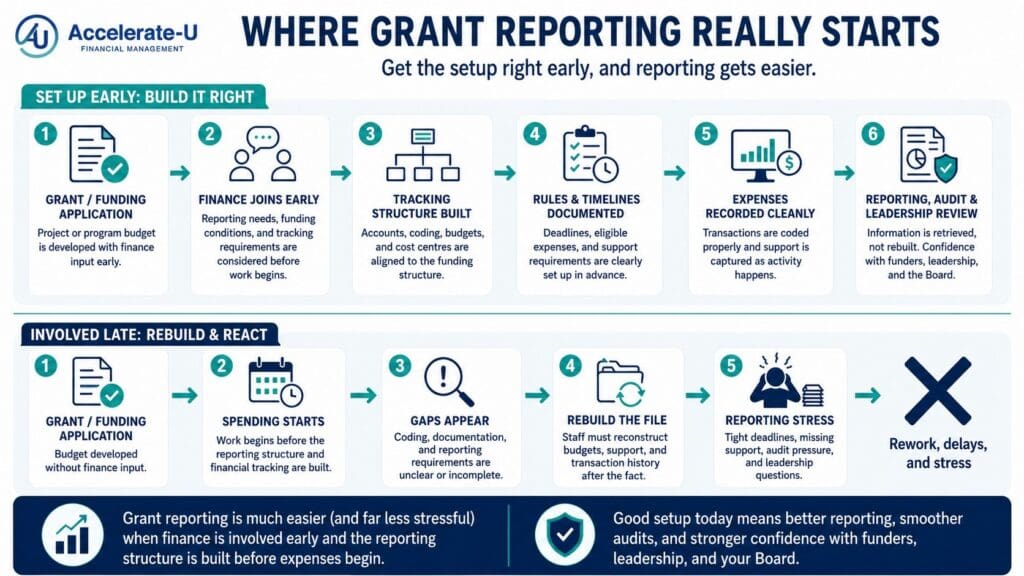
The issue is often setup, not bookkeeping
When funder reporting becomes stressful, it is easy to assume the problem is bookkeeping. Sometimes that is true. But often the bookkeeping simply reflects a structure that nobody designed around the reporting requirement.
A funder may approve a budget with categories such as program delivery staff, product development, research costs, outreach, participant supports, administration, equipment, evaluation, travel, or contractor costs. Your accounting system may organize expenses differently, using accounts such as wages, benefits, payroll taxes, professional fees, supplies, rent, software, equipment, and travel.
For nonprofits, this can also connect to broader questions about fund accounting and restricted contributions, especially where funding comes with external restrictions or specific reporting expectations.
Operational teams may think about the work by activity, location, milestone, customer segment, project phase, or community served. Leadership may want a higher-level view of spending, remaining funds, cash impact, restrictions, and risk. None of these views are wrong. The problem starts when the organization does not connect them.
That is why grant reporting should not begin when the report is due. It should begin when the team develops the budget, or at the latest, before anyone codes the first expense.
What grant-to-GL mapping does
Grant-to-GL mapping connects the funder’s budget to the organization’s accounting system.
In plain language, it answers this question:
If the funder asks for this budget line, where will we find it in our books?
For example, a funder may have a budget line called “Project Staff” or “Program Delivery Staff.” In the accounting system, those costs may sit across wages, benefits, payroll taxes, vacation accruals, contractor fees, or consultant costs. Some of those costs may qualify under the grant. Others may not. Some may need an allocation based on time, approved percentages, milestones, or another documented method.
A grant-to-GL map makes those decisions visible before the reporting deadline. It does not need to be complicated. For many organizations, it can start as a simple table that shows the funder budget line, the related GL account or accounts, the project/class/fund/department/location code, any eligibility notes, and the person responsible for review.
The value is not in the format. The value is in making the logic clear before transactions start flowing through the system.
Why finance should join before the application is finalized
Finance does not need to own the grant application. Program leaders, founders, researchers, and project teams should lead the design of the work, outcomes, delivery model, and case for support. But finance should join early enough to test whether the organization can track, report, and support the proposed budget.
Before the team finalizes a grant budget, finance can help ask practical questions:
- Do the funder’s categories match how we currently code expenses?
- Should payroll be split across programs, projects, or funders?
- Does the funder cap administrative or indirect costs?
- Do shared costs need an allocation method?
- Will the organization need to absorb costs the funder does not cover?
- Could reimbursement timing affect cash flow?
- What documentation will we need later to support the claim?
These questions should not slow down the application. They should protect the organization after the funder approves the work.
This matters because funders often define eligible and ineligible costs differently. For example, federal eligible cost guidance notes that eligible direct costs depend on the nature of the project and may include items such as salaries and travel costs where appropriate.
A grant budget can look reasonable in a proposal and still create problems later if the accounting system cannot track it cleanly. When finance joins earlier, the team can build a budget that is not only fundable, but manageable.
What to set up before spending starts
Once the organization receives a grant, contribution agreement, contract, restricted fund, or funded project, the team should take time to translate the award into the finance system before spending begins.
At a minimum, the organization should review the approved funder budget and identify the reporting categories, eligible costs, ineligible costs, caps, approval requirements, and deadlines. The team should then map each budget line to the chart of accounts and to any tracking dimensions the organization uses, such as project, class, fund, department, location, customer, or program.
Payroll and shared costs deserve particular attention. Many reporting challenges start with people costs, especially when staff work across multiple programs or projects, or when costs such as supervision, rent, administration, software, or technology support more than one funding source. The allocation method does not need to be overly complex, but it should be clear, reasonable, and documented.
The organization should also set up a simple documentation structure before documents start arriving. Invoices, receipts, contracts, payroll support, approvals, funder correspondence, budget amendments, and submitted reports are much easier to manage when everyone knows where they belong from the start.
This is not only useful for funder reporting. It also supports broader recordkeeping expectations. The CRA’s guidance on keeping business records explains the requirements for retaining records and supporting documents, while its charity guidance also emphasizes the need for adequate books and records for registered charities.
None of this requires a large finance department or expensive software. It does require a clear setup and a shared understanding of how the organization will manage the funding.
The audit piece
The audit angle matters because restricted or externally funded activity needs to be supportable.
Auditors and reviewers are not trying to make grant reporting harder. They want to confirm that the organization recognized, spent, deferred, restricted, or reported funds appropriately. They also need the organization to support the numbers behind the financial statements, schedules, claims, or funder reports.
That is why the setup matters so much: the organization should be able to move from the approved budget to the accounting records to the supporting documentation without rebuilding the file from scratch.
When the grant setup is clear, the audit conversation becomes much easier. Instead of explaining months later why the organization included a cost, how it calculated a payroll allocation, or where the team stored the support, the organization can show the approved budget, the grant-to-GL map, the allocation method, the transaction report, and the supporting documentation.
That does not remove every audit or review question, but it changes the nature of the conversation. The team is no longer rebuilding the story under pressure. It can retrieve information that it organized as the work happened.
For a stretched finance team — or a founder still managing finance alongside everything else — that difference matters.
What leadership should care about
Leadership does not need to review every coding decision, and the Board or Finance Committee should not get pulled into the details of every invoice or journal entry. But for significant grants or funded projects, management, founders, executives, and directors should have confidence that the organization can answer the right questions.
- Are we spending according to the approved budget?
- Have we separated restricted or committed funds from flexible operating funds?
- Are we carrying costs we may not recover?
- Can we support payroll and shared-cost allocations?
- Can we see reporting deadlines early enough?
- Do we have the documentation the funder, auditor, reviewer, or investor may request?
These are governance and leadership questions, not bookkeeping details. Good grant setup gives decision-makers better oversight without creating unnecessary operational involvement.
This is one example of why finance should be treated as a strategic asset, not just an administrative function. When finance is involved early, the organization is better able to design work that can be funded, tracked, reported, and governed properly.
The bottom line
New funding should create momentum, not reporting chaos.
When finance joins early, the organization has a better chance of building a budget that it can track, report, and support. When finance joins late, the team can still do the work, but it often becomes harder, slower, and more dependent on manual cleanup.
Grant-to-GL mapping is not a finance department luxury. It is a practical setup step that protects staff time, strengthens funder reporting, supports audit readiness, and gives leadership more confidence in the numbers.
Before the next grant starts, ask one simple question:
Can our finance system report on this clearly, or are we relying on someone to rebuild the story later?
Download the Grant Reporting Setup Checklist
Accelerate-U has created a practical checklist to help mission-driven organizations set up the finance structure behind a new grant, contribution agreement, contract, restricted fund, or funded project before spending begins.
Use it to clarify the approved budget, eligible costs, grant-to-GL mapping, tracking structure, payroll and shared-cost allocations, documentation, reporting deadlines, monthly review, and leadership visibility.
Starting a new grant or funded project? Book a 30-minute Grant Reporting Setup conversation.
Leave a Comment