
Finance Should Do More Than Report History

Accurate reporting is the foundation. Leaders also need interpretation, forward visibility and disciplined follow-through to make sound decisions.
Your leadership team is considering an important opportunity.
It may be a new funded program, a key hire, a major contract, an investment in technology or an expansion into a new market. The finance team has prepared the latest financial reports, closed the books, recorded revenue and expenses, reconciled the accounts and compared the results with budget.
Yet the decision is still unclear.
The reports show what happened last month, but they do not necessarily show whether the organization can afford the opportunity, absorb the additional work or sustain the commitment after leadership makes it.
That does not mean the reporting is wrong. It means the organization now needs finance to provide something more.
Accurate records are the foundation of a strong finance function, but they are not the end point. As decisions become more complex, leaders need financial decision support that combines accurate reporting with interpretation, forward visibility and disciplined follow-through..
Finance should do more than report history. It should help leaders understand what the organization can realistically do next.
Reporting history still matters
Moving beyond historical reporting does not reduce the importance of bookkeeping, reconciliations or a reliable month-end close.
Those disciplines are essential.
The finance function needs to pay bills correctly, recognize revenue and expenses in the appropriate periods, run payroll, reconcile bank and balance-sheet accounts, track grants, contracts, projects and restricted funds accurately, and produce financial statements consistently.
This work supports compliance, governance, audit readiness and confidence among boards, funders, lenders and investors. It also gives leadership a dependable understanding of the organization’s financial position.
Without that foundation, forecasts become unreliable and analysis becomes little more than guesswork. A decision is only as sound as the information supporting it.
The problem arises when the finance process ends there.
A strong close explains what happened. Leadership must still understand why it happened, what is likely to happen next and what the information means for the choices in front of them.
Why historical reporting can leave a leadership gap
Most financial statements primarily summarize completed activity.
An income statement shows the revenue earned and expenses incurred. A balance sheet shows the organization’s assets, liabilities and accumulated results at a particular date. A budget comparison shows how actual results differed from the original plan.
All of this is useful. But consequential decisions are usually about the future.
Should the organization hire another person? Can it take on a major project? Does a new program have enough funding to cover all of its costs? How much runway remains if revenue arrives later than expected? Will increased activity improve financial sustainability or simply create more pressure on people and systems?
Historical reports rarely answer those questions on their own. They may not show when the organization will actually receive or spend cash, or distinguish recurring activity from one-time events. The operational assumptions behind the budget may also remain unclear, along with whether the organization has the people, systems and management capacity to deliver what leadership is considering.
The result is a familiar leadership experience: more financial information, but not necessarily more clarity.
A board may receive a detailed financial package without understanding which decisions require its attention. A leadership team may see that expenses remain within budget without knowing whether the organization can support upcoming commitments. A leader may see revenue increasing without knowing whether margins, working capital or delivery capacity are improving with it.
In these situations, the reports are not necessarily inaccurate. They are simply not yet providing enough support for the decisions the organization now faces.
What decision-support finance adds
Decision support does not replace reliable reporting. It builds on that foundation by giving leaders the tools to look ahead, test assumptions, understand trade-offs and monitor results after they make a decision.
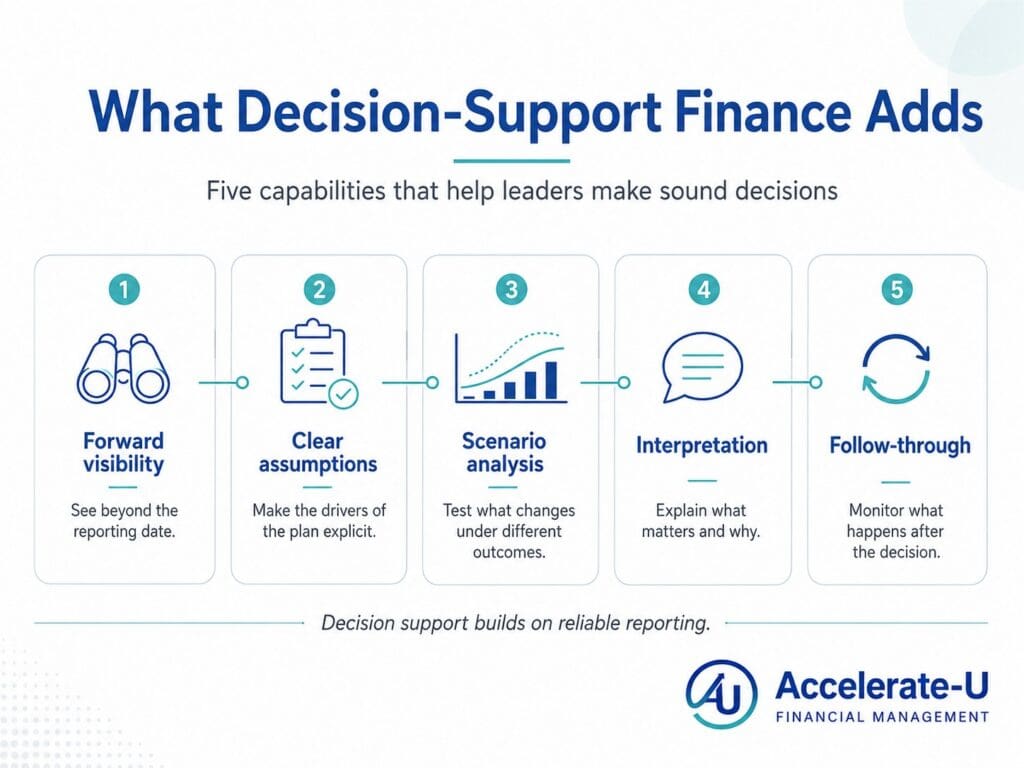
Together, these capabilities connect financial information to leadership action. A cash-flow forecast may reveal timing pressures that annual results do not show. Scenario analysis can demonstrate how a hire, program or major project affects cash and capacity under different assumptions. Interpretation helps leaders understand what matters and why, while follow-through helps them monitor the decision, test their assumptions and adjust course as circumstances change.
Finance then becomes part of the organization’s operating rhythm—not only the process that produces its financial reports. Effective financial decision support connects reliable information to the choices leadership is considering.
The same gap appears in different organizations
Decision support matters across sectors and organization types. The circumstances vary, but leaders often face the same underlying challenge.
Consider a nonprofit evaluating a new funded program. The grant may appear to cover the program budget, but leadership also needs to understand the full cost of administration, supervision, reporting and shared infrastructure. It needs to know when reimbursements will arrive, whether unrestricted cash can support the timing gap and whether the organization has enough staffing capacity to deliver the program responsibly.
The decision is not simply whether the funding is available. It is whether the organization can deliver the work without weakening the rest of its operations.
An early-stage company considering a key hire faces a different version of the same question. The annual salary may fit within the forecast, but leadership also needs to consider the timing of the hire, the expected contribution to key milestones, the effect on runway and what happens if revenue or investment arrives later than expected.
The question is not only whether the company can afford the salary. It is whether the commitment strengthens the path forward under a reasonable range of outcomes.
A climate organization, social enterprise or impact-oriented company considering a large contract or project may see an opportunity to advance its purpose and increase revenue. But revenue alone does not determine whether the opportunity is financially sound. Leadership must understand the margin, payment terms, working-capital requirements, delivery risk and pressure the project will place on existing people and systems.
The question is not only whether the organization can win the work. It is whether winning the work will strengthen the organization.
In each case, historical reporting provides part of the answer. Decision support connects the financial information to the commitment leadership is considering.
From records to execution
Finance capacity often develops through a recognizable progression. Reliable records enable consistent reporting. Reporting creates insight. Insight supports better decisions, and leaders then translate those decisions into responsibilities, measures and follow-through.
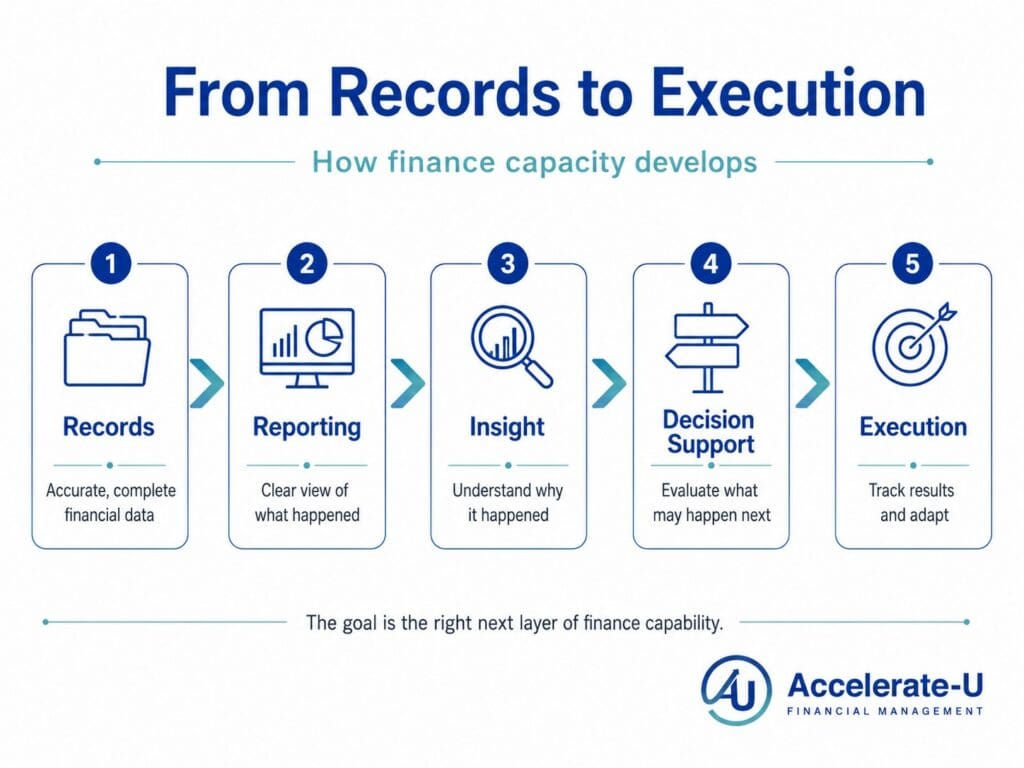
The important point is not that every organization should build the most sophisticated finance function possible. The goal is to develop the next layer of capability required by the decisions the organization is now making.
For one organization, that may mean clean bookkeeping, a dependable close and a rolling cash forecast. Another may need stronger management reporting, project costing or scenario planning. A more complex organization may need controller oversight, systems improvement and strategic finance leadership working together.
The right question is not:
“How do we build the biggest finance function?”
It is:
“What finance capacity do our current decisions require?”
Underbuilding can leave leaders without the visibility and support they need. Overbuilding can add unnecessary cost and complexity. The right next step is the one that helps the organization make sound decisions and carry them through into execution.
Questions leaders should expect finance to help answer
A useful test of financial reporting is whether it makes the decision easier to understand.
Before making an important commitment, leaders should be able to ask:
- What decision is this information helping us make?
- Which assumptions have the greatest effect on the outcome?
- What changes if revenue, funding, timing or cost differs from plan?
- What is the cash impact, and when will it occur?
- Do we have the people and operating capacity to deliver what we are considering?
- What should leadership monitor after making the decision?
Finance may not produce a single definitive answer. Many leadership decisions involve uncertainty, values, relationships and strategic judgment that cannot be reduced to a spreadsheet. What finance can do is make the assumptions clearer, identify the trade-offs, show the range of possible outcomes and help leaders understand what must be true for the decision to succeed.
Finance improves judgment; it does not replace it
Leaders remain responsible for deciding what the organization pursues, which risks to take and how to allocate resources. The role of finance is not to make every choice on leadership’s behalf. It is also not to become the department of “no” or create unnecessary obstacles around every new idea.
Strong finance helps leadership say:
“Yes, and here is what needs to be true for this to work.”
“Yes, but here are the risks we will need to manage.”
“Not yet, but here is what we need to strengthen before we commit.”
That is a very different role from simply explaining the past after the most important decisions have already been made.
Closing the books matters. Accurate reporting matters. But neither should be the finish line.
When finance combines reliable information with interpretation, forward visibility and follow-through, it becomes part of how the organization turns ambition into execution. I would be interested to hear how other leaders experience this. Where does your finance function genuinely help with decisions—and where does it still mainly report what has already happened?
Is your finance function keeping pace with your decisions?
If your financial reporting is accurate but still does not provide the visibility you need to evaluate important commitments, the next step may not be more reports. It may be a stronger layer of forecasting, interpretation and decision support.
Accelerate-U helps leaders develop the financial decision support their organization needs next—and develop the right level of support for their organization’s stage, complexity and ambitions.
If you’re thinking about what your finance function needs to provide next, I’d be happy to chat and compare notes. Find a time that works for you.
Leave a Comment