
Growing Demand, Thin Teams, and Rising Risk

Why Finance Capacity Matters More Than Ever
Growing demand and rising complexity are putting unprecedented pressure on mission-driven organizations—and the breaking point is rarely where leaders expect. More often than not, it’s the finance function.
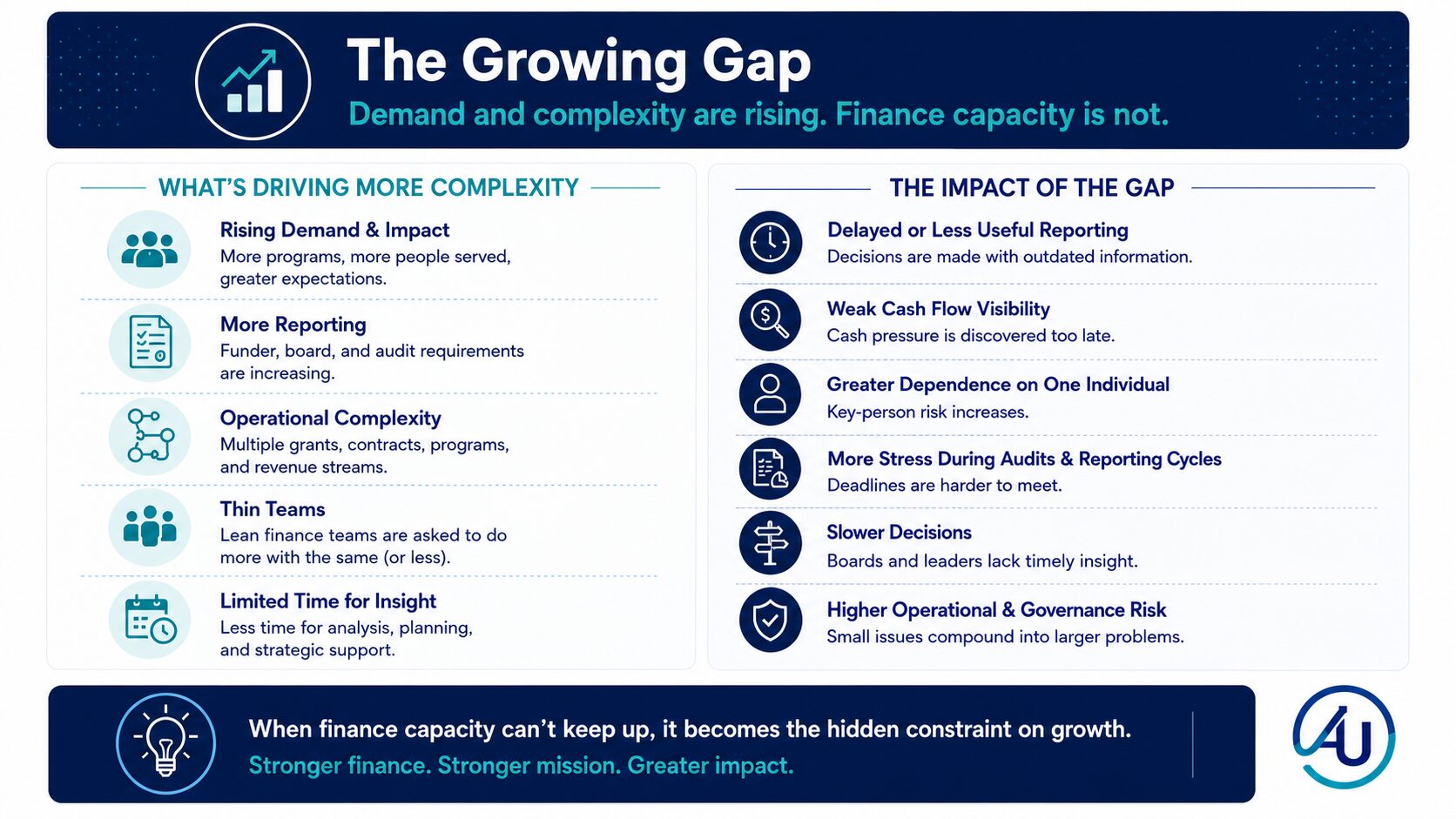
Mission-driven organizations are being asked to do more in a more demanding environment. Demand is rising. Reporting expectations are rising. Operational complexity is rising. But internal finance capacity often is not.
For many leaders, the pressure first shows up in staffing, fundraising, or program delivery. But underneath those visible strains is a quieter issue that has become increasingly important: the finance function is struggling to keep pace with the organization it is meant to support.
For nonprofits, social enterprises, and other impact-focused organizations, this matters more than ever. Finance is not just an administrative function. It is part of the infrastructure that supports stability, accountability, and informed decision-making.
Growth is creating more complexity
Growth is not always a problem. In many cases, it reflects stronger demand, broader reach, and greater impact, but growth also changes what an organization needs from its finance function.
An organization that once operated with a simple structure may now be managing multiple programs, restricted grants, contract revenue, payroll complexity, inter-program allocations, board reporting, and audit preparation all at once. The mission has expanded, but the systems, reporting processes, and finance support behind it may still look like they did at an earlier stage.
That mismatch creates strain.
Thin teams are carrying too much
Many mission-driven organizations are operating with lean internal teams. That reality is understandable, especially in sectors where resources are stretched and leadership is focused on maximizing impact.
But lean teams can quickly become overextended when financial complexity increases.
In practice, this often means one person is carrying too much institutional knowledge, reporting takes too long, month-end closes drift, and leadership lacks timely visibility into what is really happening. Teams spend more time reacting than planning.
This is not usually a people problem. It is a capacity problem.
Why finance capacity is now a growth issue
When finance capacity falls behind, the consequences reach beyond bookkeeping. The financial infrastructure that once fit the organization no longer does, and the effects show up across the board:
- Delayed or less useful reporting
- Weak cash flow visibility
- Greater dependence on one individual
- More stress during audits and funder reporting cycles
- Slower decisions from leadership and boards
- Increased operational and governance risk
At that point, finance capacity becomes more than a back-office concern. It becomes a growth issue.
Because when leaders cannot see clearly, plan confidently, or rely on timely financial information, it becomes harder to scale responsibly.
Risk rises when visibility falls
One of the biggest challenges is that finance strain does not always look dramatic at first.
It can show up as small delays, workarounds, spreadsheet duplication, or uncertainty around cash. But over time, those issues compound. A missed reporting deadline, an unclear funding position, or an overreliance on bank balance instead of forecasting can create avoidable risk.
Boards and executive leaders should pay attention to this. Finance weakness is not just an operational inconvenience. In many organizations, it is also a governance issue.
What leaders should be asking
If your organization is growing, this is the right time to ask whether your finance capacity still matches your current stage.
A few useful questions include:
- Are our reports timely, reliable, and decision-useful?
- Can we see cash flow pressure before it becomes urgent?
- Are finance responsibilities too concentrated in one role?
- Do our systems reflect how the organization actually operates?
- Is leadership getting the level of financial insight needed to manage risk and growth?
These questions can help identify whether the pressure point is staffing, structure, systems, reporting, or a combination of all four.
Stronger finance capacity supports stronger mission delivery
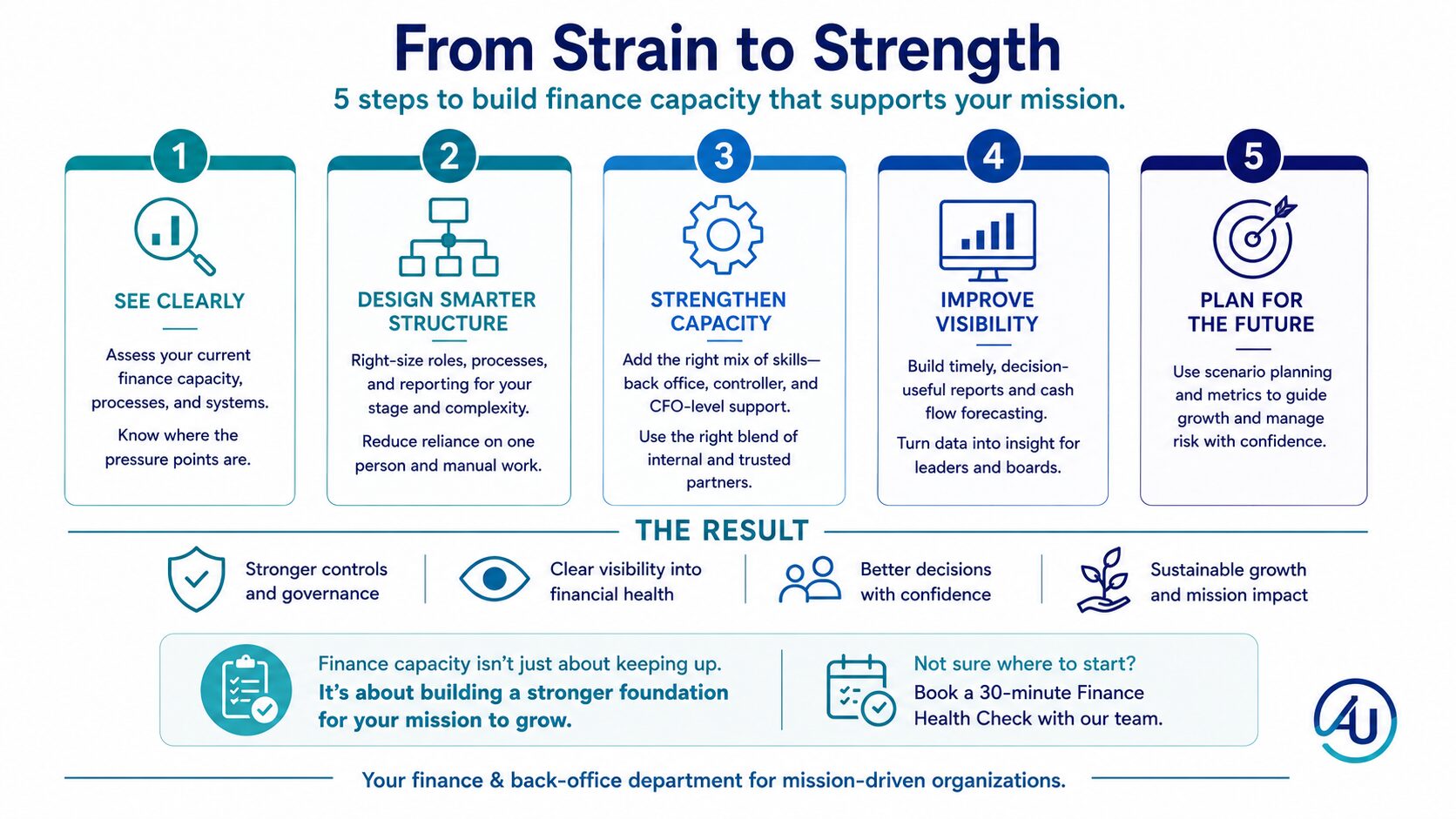
The answer is not always to build a large in-house team. Often, the better next step is to strengthen the finance function in a way that fits the organization’s size, complexity, and ambitions.
That may mean improving reporting, tightening processes, adding controller-level support, strengthening cash flow visibility, or building a more resilient finance structure overall.
The goal is not complexity for its own sake. The goal is to make sure the finance function is strong enough to support the mission it serves.
When finance capacity keeps pace with growth, leaders gain clearer visibility, better control, and more confidence in the decisions ahead.
If your organization is growing but your finance capacity feels stretched, it may be time to take a closer look. Download our whitepaper, From Mission Stretch to Operational Strain, or reach out to schedule a Finance Health Check call and talk through what stronger finance support could look like for your team.
Leave a Comment