
Finance Maturity, Year-End Close, and Audit Readiness

Why finance pressure builds long before year-end—and what it reveals
Audit readiness is built deliberately throughout the year, through disciplined close processes—not just in the lead-up to the audit.
Year-end doesn’t create finance problems, it reveals the ones you have carried all year.
That’s a frustrating thing to sit with when you’re in the middle of it — chasing down reconciliations, fielding auditor requests, trying to pull together information that should have been organized months ago. But understanding why year-end gets hard is actually the most useful place to start. Because if you only address the symptoms, the same pressure tends to show up again the following year.
If you’re an ED, CEO, or finance lead trying to keep reporting stable through a period of growth, what follows will probably feel familiar. And if you’re somewhere in the middle — things are mostly working but it keeps getting harder — that’s actually where this is most useful.
How pressure builds — and what it actually reflects
For most organizations, year-end feels like a distinct moment. A deadline with a capital D. There’s a push, a period of intensity, and then — eventually — it’s over.
But what you’re experiencing at year-end isn’t really caused by year-end. Finance operations accumulate friction throughout the year, and it surfaces when teams are least equipped to handle it. Rarely does a single event trigger it. Programs expand, reporting demands grow, funding structures become more complex — but the finance function, including processes, systems, and structure, often remains unchanged. Initially, teams adapt, workarounds bridge the gaps, and for a period, those adaptations suffice.
The hidden cost of workarounds
The problem is that workarounds have a way of becoming the process. What started as a temporary fix becomes the default, and by the time the organization notices the friction, it’s deeply embedded. That’s where year-end pressure actually lives.
This matters because finance, in mission-driven organizations, is often treated as a support function — necessary, but not strategic. As organizations grow, though, it becomes something more foundational: the infrastructure that supports visibility into performance, confidence in decision-making, the ability to plan ahead, and the capacity to respond to risk. When that infrastructure doesn’t keep pace, the effects ripple outward — beyond the finance team, into operations, governance, and leadership.
Think of it this way: a small nonprofit with one funding stream and a part-time bookkeeper can often manage with a basic setup. But once there are three funders, multiple contracts per funder, separate reporting requirements per contract, a payroll cycle, and a board expecting quarterly reports, that same setup starts to strain. The structure was never updated to match the current needs.
Where the pressure shows up — including what’s harder to see
While every organization is different, the same patterns tend to emerge. Finance work becomes concentrated in a small number of individuals, with knowledge living in people rather than in documented processes. The year-end close process can be more complex for nonprofits, not just because funds from approved grants may not be released immediately, but they also need to have clarity on if the grant amounts have been earned, all the while payroll and other expenses still need to be managed in the interim. Repetition of this gap across funders creates unexpected pressures, even for solvent organizations.
Reporting challenges and capacity gaps
What makes this harder to fix is that these issues are rarely isolated. Reporting challenges are linked to capacity. Capacity challenges are linked to structure. Cash visibility is shaped by how funding is timed and how costs are covered. Trying to fix one area without understanding the others tends to produce limited and short-lived results.
Here’s a pattern I see fairly often: an auditor asks for supporting documentation on a few balances, and suddenly someone is rebuilding months of backup from email threads and spreadsheets — right in the middle of the busiest stretch of the year. Nothing was lost, technically. It was just never organized in a way that could be retrieved quickly. For organizations managing restricted funding across multiple funders, program contracts, and program-level reporting, that problem multiplies fast.

Link reporting, capacity, and structure deliberately. Address interconnected challenges as a system, not in isolation, for sustained improvements.
Some of the most important pressure points sit even further below the surface. Programs or services that don’t fully cover their costs. Reliance on cross-subsidization that nobody has quite named out loud. Growth that increases complexity without improving financial capacity. A structural model that no longer quite matches how the organization actually operates. In mission-driven organizations, this often shows up as a quiet tension between impact and financial sustainability — one that doesn’t get resolved until something forces the conversation.
Audit readiness is a byproduct, not a project
Audit disruption is minimized when organizations commit to rigour throughout the year, not just at year-end. Establish habits that ensure consistent audit readiness.
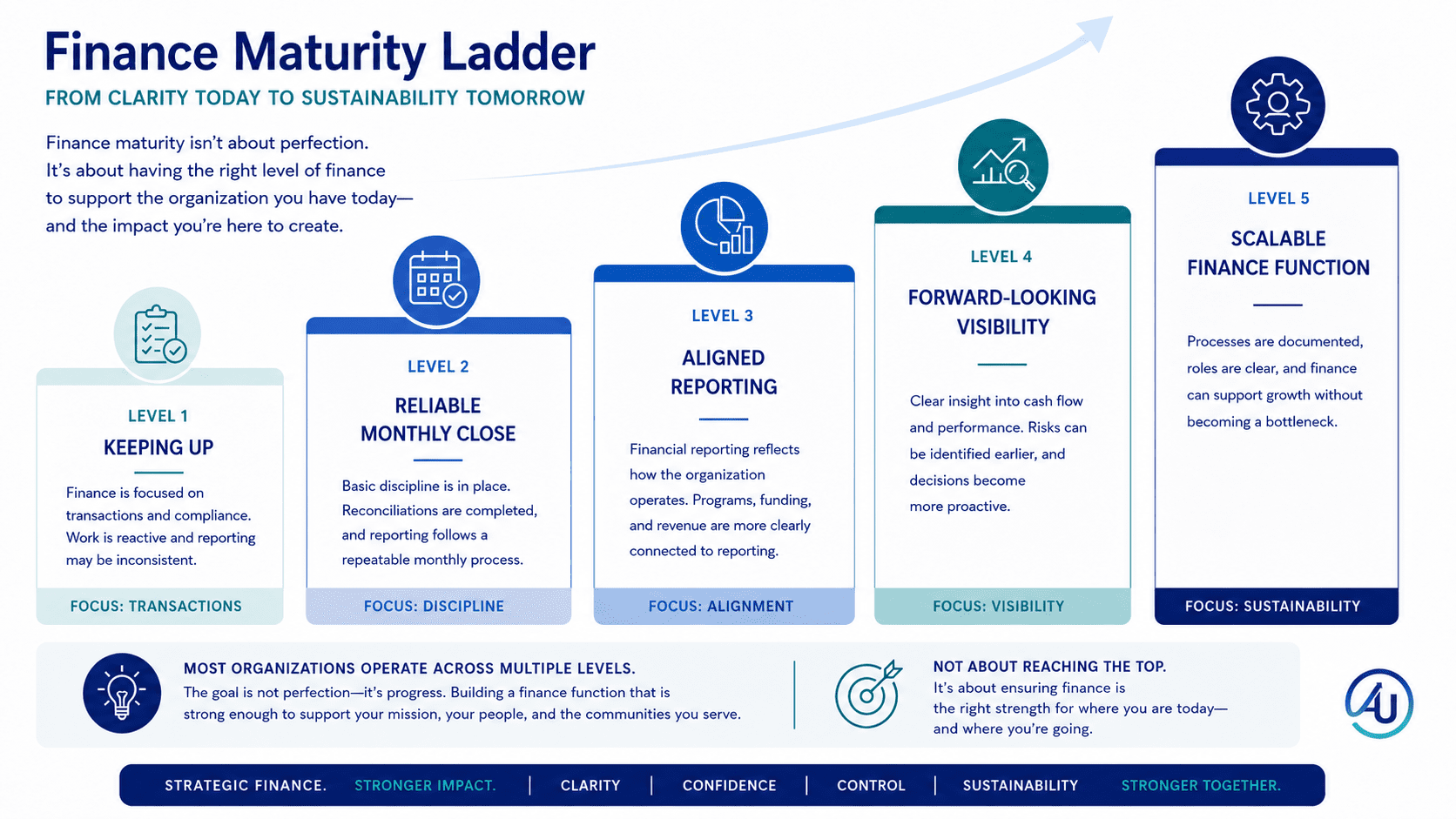
It’s useful to think about finance function development as a progression rather than a binary. Most organizations aren’t fully broken or fully functioning — they’re somewhere in between, with some areas working well and others lagging behind. A common pattern is strong bookkeeping, but weak reporting — the numbers are there, but producing something board-ready still takes days of manual effort. Or solid month-end processes, but poor documentation. The close happens, but the evidence isn’t organized in a way that holds up under scrutiny. The goal isn’t to reach some abstract ideal. It’s to understand where the friction is showing up, and what would make next month calmer and next year-end more manageable.
Steps towards smoother audits
When organizations experience smoother audits, a few consistent factors usually explain why. Teams maintain a clear, close process with defined responsibilities — everyone knows what to do, by whom, and by when. Teams complete reconciliations regularly rather than catching up at year-end. They organize documentation for quick retrieval, not reconstruction under pressure. They treat revenue and expenses consistently from one period to the next. Clear approval and review processes ensure the right people finalize everything.
When those things are in place, audit becomes largely a confirmation of what you already know — not a disruption that derails your team for weeks. The auditors ask for something, and it is found within minutes rather than having to build reports over days. That difference alone changes how year-end feels for everyone involved. As mentioned in the beginning, Audit readiness is built deliberately throughout the year.
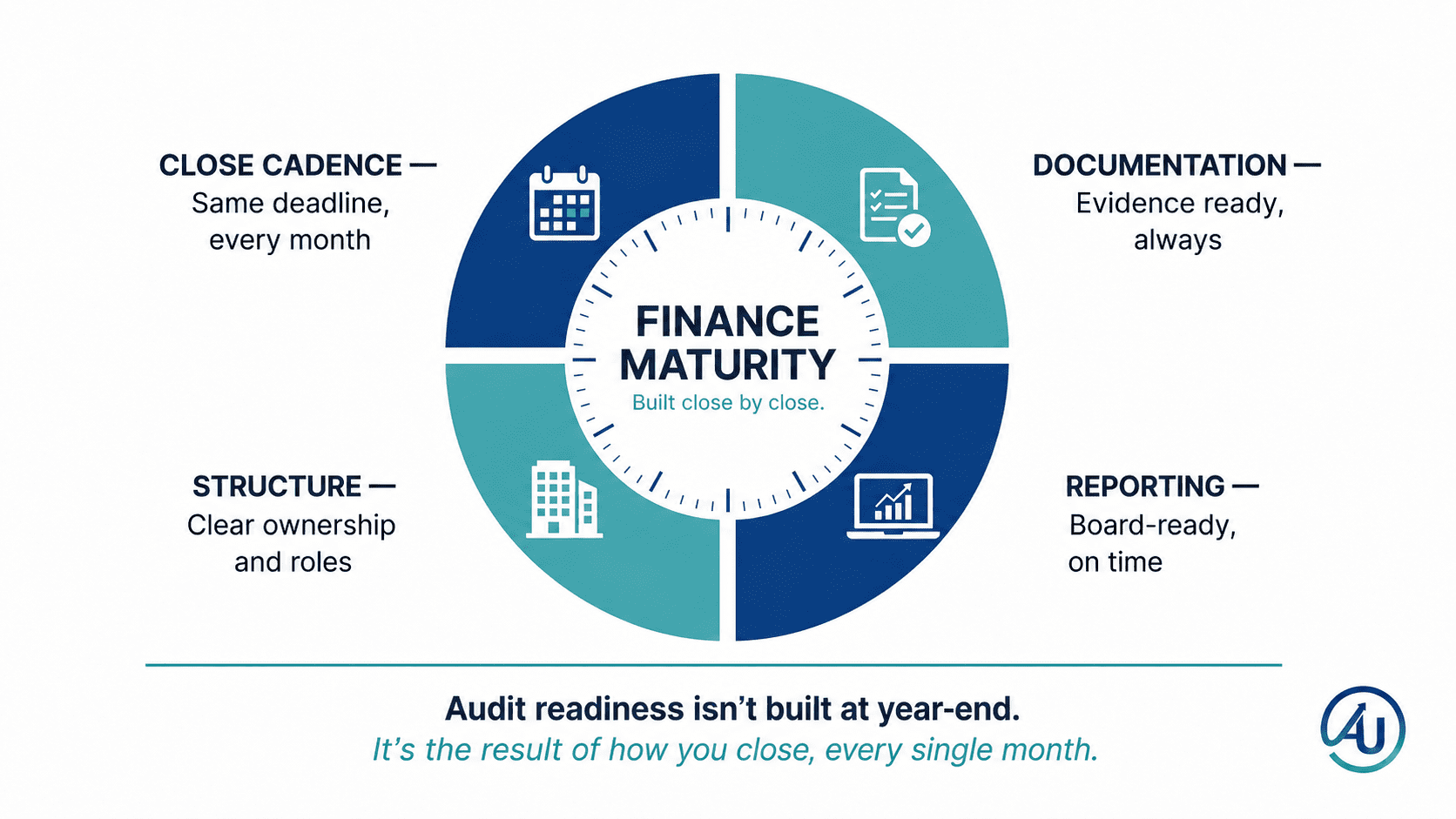
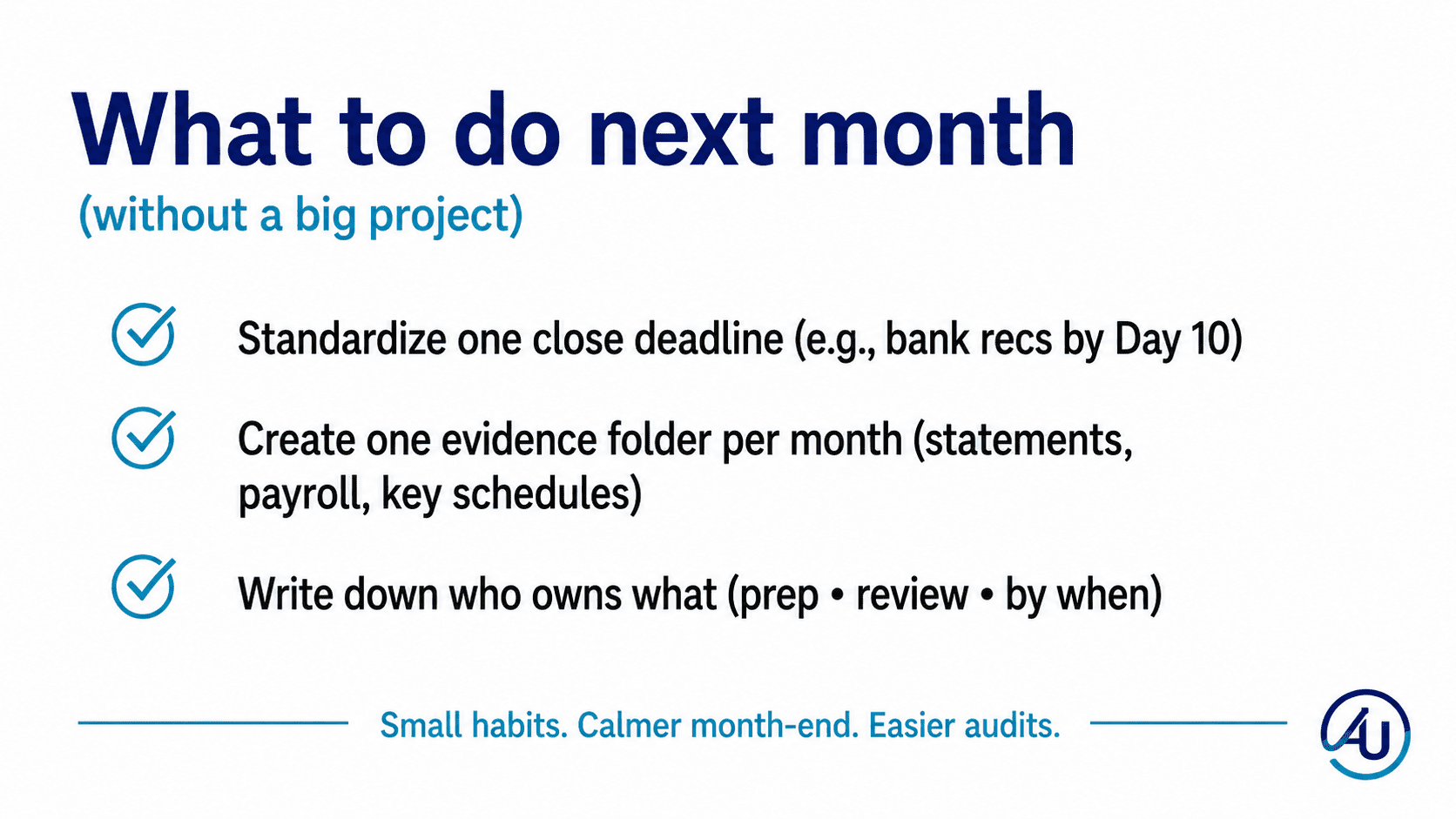
I’ve seen teams cut audit disruption significantly just by standardizing one close deadline, building a monthly evidence folder, and clarifying who reviews what before anything goes out the door. Nothing extraordinary — just consistency applied deliberately. If you’re not sure where to start, three small changes can make a meaningful difference:
Pick one close deadline to standardize — for example, bank reconciliations by Day 10. Create one repeatable evidence folder for each month, containing your key statements, reports, and schedules. And write down, even briefly, who owns what: who prepares, who reviews, and by when.
That’s it to start. It won’t fix everything at once, but consistency over a few months meaningfully changes what year-end looks like — and more importantly, how much effort it takes to get there.
What gets better — and how to think about next steps
1. Board reporting transforms as finance matures
As your finance function matures, board reporting becomes a genuine governance tool. Reports shift from historical summaries to forward-looking analysis. Detail gives way to insight. The board stops processing data and starts making decisions. This shift is more achievable than most leaders expect — if your team can defend figures under audit scrutiny, you can present them clearly to the board. The discipline is the same.
2. Ask the right diagnostic questions
If your finance function feels stretched, start here:
- Are your reports timely, reliable, and useful for decision-making?
- Can you spot cash flow pressure before it becomes a problem?
- Is financial knowledge concentrated in one person?
- Do your systems reflect how you actually operate today?
These questions don’t have one right answer, and the goal isn’t to grade yourself. Use them to find the biggest gap between your current finance function and your current organizational complexity. That gap is usually where the highest-value work lives. One or two of these questions will hit harder than the others. That’s your signal. Organizations that focus there tend to see improvements across the board, not just in the targeted area — because so much of finance function health is interconnected.
3. Strengthen before you scale
The next step isn’t always to hire a larger team. For most organizations at the $1–10M stage, the priority is strengthening the finance function to fit where the organization actually is. That means improving reporting consistency, clarifying processes and ownership, building cash visibility, and aligning systems with operations. This is often a smaller lift than it sounds — and the downstream effects on audit readiness, board reporting, and leadership confidence can be significant.
4. Recognize the common thread
Year-end close, audit readiness, and reporting challenges aren’t separate problems. They all reflect the same underlying question: does your finance function support the organization as it operates today? When finance keeps pace with growth and complexity, year-end becomes a milestone rather than a crisis. The close still happens. The audit still comes. But neither derails the team or forces a scramble.
More importantly, the organization builds something that compounds over time — clearer visibility, stronger controls, and greater confidence in the decisions ahead. A well-functioning finance department doesn’t feel exciting from the inside. It feels steady. And for mission-driven organizations doing more with constrained resources, steadiness is enormously valuable.
Audit readiness is built deliberately throughout the year!
What is your biggest audit pain point right now?
Share your thoughts, questions, or experiences in the comments below. If you recognize any of these patterns in your organization or have tips for making audits smoother, I’d love to hear from you.
Let’s start a conversation — your insights might help others facing the same challenges.
Or reach out if your organization is growing but finance feels increasingly stretched; it may be worth pausing to take stock. A short Finance Health Check can help you see where pressure is building — and what to prioritize next.
Leave a Comment